

Detection target
Determination of solvent residue content in packaging materials
Introduction
Solvent residue testing in packaging materials targets the organic solvents (such as toluene, xylene, ethyl acetate, ethanol, isopropanol, and acetone) used in the manufacturing and processing of packaging for products such as food, pharmaceuticals, cosmetics, and medical devices. Gas chromatography is used for precise measurement to ensure that the levels of residual volatile organic compounds (VOCs) and semi-volatile organic compounds (SVOCs) in the packaging materials comply with relevant standards. This prevents solvents from contaminating the packaged products through migration, permeation, or release, thereby mitigating potential risks to consumer health (such as toxicity, carcinogenicity, and unpleasant odors).
Overview
This solution conforms to the ASTM D1884 Standard Test Method for Determining Residual Solvents in Packaging Materials. Retained volatile organic solvents are determined by subjecting the packaging material to elevated temperatures in a headspace sampling system, followed by gas chromatographic analysis of the headspace gas and detection using a suitable detection device such as a flame ionization detector (FID).
Apparatus
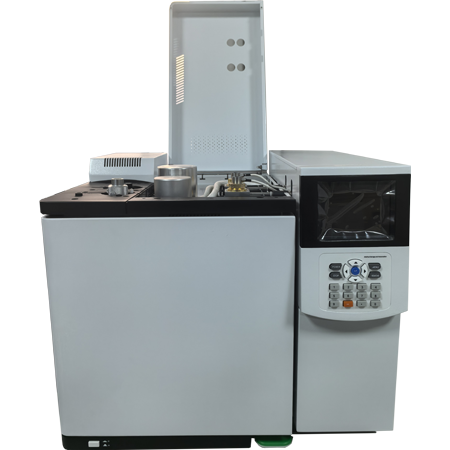
HKL-1884 Gas Chromatograph for Residual Solvents
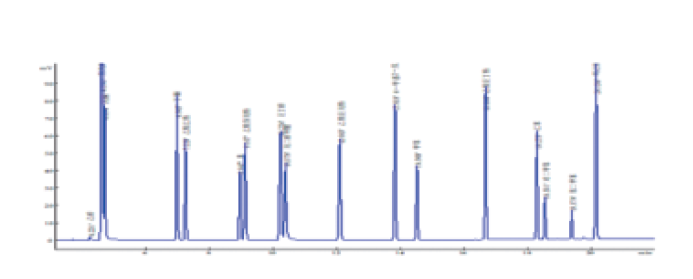
Chromatogram
Configuration
Serial | Name | Specification | Number |
1 | Gas Chromatograph | HKL-1884 | 1 set |
2 | Chromatography column | 1 pc | |
3 | Sample | 1 set | |
4 | Workstation | Data acquisition system | 1 set |
5 | Air generator | 1) Air purity: Oil-free, triple filtration 2) Output flow: 0-3 L/min 3) Input pressure: 0-0.4MPa (adjustable) 4) Rate power: 150W | 1 set |
6 | Hydrogen generator | 1) Hydrogen purity: 99.999% 2) Output flow: 0-300 ml/min 3) Input pressure: 0-0.4 Mpa 4) Rate power: <150W | 1 set |
7 | Nitrogen cylinder | Purity: 99.999% (with regulator) | User-provided |
8 | Computer + printer | User-provided |