

Detection Target
Determination of impurities in aluminum oxide
Overview
This solution conforms to the ISO 3169 Fine ceramics (advanced ceramics, advanced technical ceramics) — Methods for chemical analysis of impurities in aluminium oxide powders using inductively coupled plasma-optical emission spectrometry. Aluminium oxide powders are decomposed by acid pressure decomposition, acid decomposition or alkali fusion. The calcium, chromium, copper, iron, magnesium, manganese, potassium, silicon, sodium, titanium, zinc and zirconium contents in the test solution are determined by an inductively coupled plasma-optical emission spectrometer (ICP-OES).
Introduction
Ruby and sapphire are both primarily composed of aluminum oxide, with varying colors due to other impurities. Sapphire, however, is blue due to its iron and titanium oxide content. Among bauxite, the main component of aluminum ore, aluminum oxide is the most abundant. Alumina contains the elements aluminum and oxygen. Chemical treatment of bauxite removes oxides of silicon, iron, and titanium, resulting in a highly pure alumina. Alumina is a highly hard compound with a melting point of 2054°C and a boiling point of 2980°C. It forms ionic crystals that ionize at high temperatures and is commonly used in the manufacture of refractory materials.
Based on the above background research, the HKL-3169 ICP for Determination of impurities in aluminum oxide was used to detect trace elements in alumina containing impurities. The main research was to determine the content of possible metal elements in alumina, such as titanium, copper, magnesium, manganese, calcium, zinc, chromium, silicon and iron.
Principle
Under the action of a microwave digestion system, the test sample is digested with sulfuric acid under high temperature and pressure. The resulting solution is introduced into argon plasma, and the measurement is performed using an inductively coupled plasma optical emission spectrometer (ICP-OES) under optimized operating conditions. Matrix effects are corrected using a matrix-matching calibration method.
Instruments and Reagents
1.Reagent
1) Water (deionized, grade II)
2) Hydrochloric acid (guaranteed reagent)
3) Nitric acid (guaranteed reagent)
4) Standard solutions of silicon (Si), iron (Fe), sodium (Na), potassium (K), copper (Cu), magnesium (Mg), calcium (Ca), chromium (Cr), vanadium (V), zinc (Zn), titanium (Ti), manganese (Mn), and gallium (Ga) were prepared. The concentrations were as follows: 100 μg/ml for Si, K, V, and Ti 1,000 μg/ml for Fe, Na, Cu, Mg, Ca, Cr, Zn, Mn, and Ga.
2.Instrument
1) Microwave Digestion System: Rated temperature 300°C, digestion vessel volume 100 ml.
2) HKL-3169 ICP for Determination of impurities in aluminum oxide
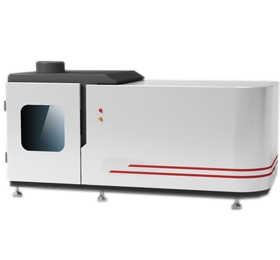
2.1 Operating parameters
2.1.1 RF power 1.25 kW
2.1.2 peristaltic pump speed 120 rpm
2.1.3 nebulizer pressure 26 psi
2.1.4 argon gas (≥99.99%)
2.1.5 Temperature (Storage and Transportation): 15°C–25°C
2.1.6 Relative Humidity (Storage and Transportation): ≤70%
2.1.7 Atmospheric Pressure: 86–106 kPa
2.1.8 Power Supply: 220 V ±10V, 50–60 MHz
2.1.9 Operating Temperature: 15°C–30°C
2.1.10 Operating Humidity: ≤70%
2.2 Technical Parameters
2.2.1 Solid-State RF Generator
① Circuit Type: Inductive feedback self-oscillating circuit, coaxial cable output, matching tuning, closed-loop automatic power feedback control
② Operating Frequency: 27.12 MHz ±0.05%
③ Frequency Stability: <0.1%
④ Output Power: 800W–1200W
⑤ Output Power Stability: <0.3%
⑥ Electromagnetic Field Leakage Radiation Intensity: Electric field strength (E) at 30 cm from the chassis: <2 V/m
2.2.2 Sample Introduction System
① Work Coil Inner Diameter: 25 mm
② Torch: Three-concentric design, Quartz Torch Outer Diameter: 20 mm
③ Concentric Type Nebulizer Outer Diameter: 6 mm
④ Double-pass Type Spray Chamber Outer Diameter: 34 mm
2.2.3 Argon Gas Flowmeter and Carrier Gas Pressure Gauge
① Plasma Gas Flowmeter: (100-1000) L/h (1.6-16 L/min)
② Auxiliary Gas Flowmeter: (10-100) L/h (0.16-1.66 L/min)
③ Carrier Gas Flowmeter: (10-100) L/h (0.16-1.66 L/min)
④ Carrier Gas Pressure Regulator: (0-0.4 MPa)
⑤ Cooling Circulating Water: Water Temperature: 20-25°C, Flow Rate: >5 L/min, Water Pressure: >0.1 Mpa
2.2.4 Monochromator
① Optical Path: Czerny-Turner configuration
② Focal Length: 1000 mm
③ Grating Specifications: Ion-etched holographic grating, Groove density: 3600 grooves/mm (optional 2400 grooves/mm available)
④ Reciprocal Linear Dispersion: 0.26 nm/mm
⑤ Resolution: ≤0.007 nm (3600 grooves/mm), ≤0.015 nm (2400 grooves/mm)
⑥ Wavelength Scanning Range: 3600 grooves/mm: 190–500 nm, 2400 grooves/mm: 190–800 nm
⑦ Stepper Motor Minimum Step Size: 0.0006 nm
⑧ Exit slit: 12 μm
⑨ Entrance slit: 10 μm
2.2.5 Photoelectric Converter
① Photomultiplier Tube (PMT) Model: R293 or R298
② PMT High Voltage Supply: 0–1000 V, stability <0.05%
2.2.6 Whole Machine
① Wavelength Scanning Range: 195 nm–500 nm (3600 grooves/mm grating), 195 nm–800 nm (2400 grooves/mm grating)
② Repeatability (Short-term Stability): Relative Standard Deviation (RSD) ≤1.5%
③ Stability: Relative Standard Deviation (RSD) ≤2%
2.2.7Detection Limit (µg/L)
Element | Wavelength | Detection Limit | Element | Wavelength | Detection Limit |
La | 408.672 | <3.0 | Cr | 267.716 | <5.0 |
Ce | 413.765 | <5.0 | Al | 396.152 | <5.0 |
Pr | 414.311 | <5.0 | Zr | 343.823 | <5.0 |
Nd | 401.225 | <5.0 | Ag | 328.068 | <3.0 |
Sm | 360.946 | <10.0 | Sr | 407.771 | <1.0 |
Eu | 381.967 | <1.0 | Au | 242.795 | <5.0 |
Gd | 342.247 | <10.0 | Pt | 265.945 | <5.0 |
Tb | 350.917 | <3.0 | Pd | 340.458 | <5.0 |
Dy | 353.170 | <3.0 | Ir | 224.268 | <10.0 |
Ho | 345.600 | <3.0 | Rh | 343.489 | <10.0 |
Er | 337.271 | <3.0 | Ru | 240.272 | <5.0 |
Tm | 313.126 | <3.0 | Ba | 455.403 | <1.0 |
Yb | 369.419 | <1.0 | As | 228.812 | ≤15 |
Lu | 261.541 | <3.0 | Sb | 206.833 | ≤15 |
Y | 371.030 | <1.0 | Bi | 223.061 | ≤10 |
Sc | 335.373 | <1.0 | Hg | 253.652 | ≤15 |
Ta | 226.230 | <5.0 | Pb | 220.353 | ≤15 |
Nb | 313.340 | <5.0 | Ga | 294.364 | ≤10 |
Mn | 257.610 | <3.0 | Se | 203.985 | ≤10 |
Mg | 279.553 | <1.0 | Sn | 242.949 | ≤20 |
B | 249.773 | <10.0 | Te | 214.281 | ≤10 |
Zn | 213.856 | <3.0 | Ta | 226.230 | ≤5.0 |
Co | 228.616 | <3.0 | Th | 283.730 | ≤10 |
Si | 251.611 | <10.0 | Tl | 276.787 | ≤30 |
Ni | 232.003 | <5.0 | Re | 227.525 | ≤5 |
Cd | 226.502 | <3.0 | Ge | 209.426 | ≤15 |
Fe | 239.562 | <3.0 | Os | 225.585 | ≤1 |
Ca | 393.366 | <1.0 | W | 207.911 | ≤10 |
Mo | 281.615 | <5.0 | Cu | 324.754 | <3.0 |
V | 310.230 | <5.0 | Li | 670.784 | ≤3 |
Be | 313.041 | <1.0 | Na | 588.995 | ≤20 |
Ti | 334.941 | <3.0 | K | 766.490 | ≤60 |
Software
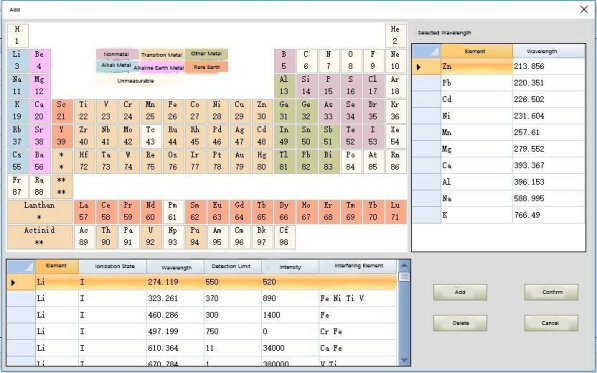 |
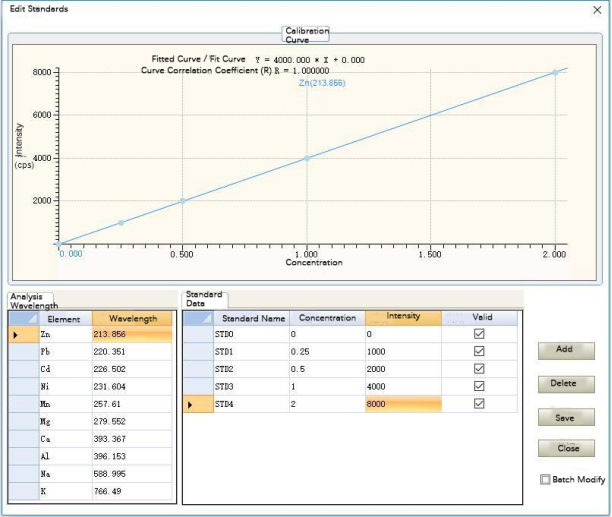 |
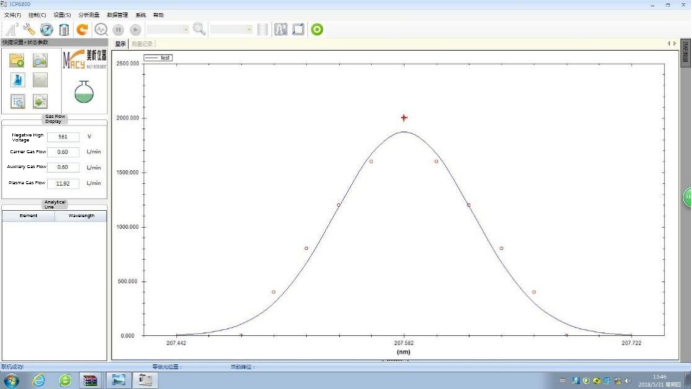 |
Digestion Procedure
The sample shall pass through a sieve with an aperture of 0.125 mm. The sample should be dried in an oven at 300°C ± 10°C for 2 hours, then cooled to room temperature in a desiccator. Weigh 0.2000 g of the sample, accurate to 0.0001 g. Perform two independent determinations and take the average value. Carry out a blank test simultaneously with the sample.
Place the sample in a polytetrafluoroethylene (PTFE) digestion vessel, add 12.0 ml of sulfuric acid (1+2), and digest in a microwave digestion system at 242°C until the sample is completely dissolved. Remove the digestion vessel and cool it to room temperature. Transfer the solution to a 100 ml volumetric flask, rinse the digestion vessel thoroughly with water, combine the rinsate into the volumetric flask, dilute to the mark, and mix well.
Calculation of Results
Input the concentrations of the standard series solutions directly into the corresponding computer software system. Based on the intensity values of the standard series solutions and the analytical test solution, the software calculates, corrects, and outputs the concentration of the target element in the analytical test solution (μg/ml). The mass fraction of the target oxide is then calculated using Formula:
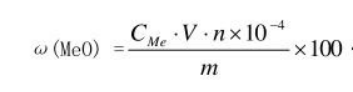
ω(MeO)—Mass fraction of the target element, in micrograms per gram (μg/g)
CMe—Mass concentration of the target element in the analytical test solution as calculated by the instrument, in micrograms per milliliter (μg/ml)
V—Volume of the analytical test solution, in milliliters (ml)
m—Mass of the test sample, in grams (g)
n—Conversion factor between the oxide and its elemental form (if the standard solution is based on the oxide, n=1).
Conclusion
A systematic study was conducted on the composition and content of other metal elements (titanium, copper, magnesium, manganese, zinc, chromium, silicon, iron, etc.) in alumina samples with unknown elemental composition and content, using an HKL-3169 ICP for Determination of impurities in aluminum oxide. The results from interference tests, calibration curves, and acid concentration tests demonstrate that the method provides accurate and reliable test results for alumina samples with unknown elemental compositions, exhibiting good precision and accuracy. No significant variations were observed in the intensity ratios of all elements, and changes in acid concentration had minimal impact on the test results.