

Detection Target
Analysis of rubber identification
Overview
This solution conforms to the ISO 4650 Rubber - Identification - Infrared spectrometric methods. This International Standard specifies two methods for the identification of rubbers, including thermoplastic elastomers, either in the raw state or in the form of vulcanized or unvulcanized mixes. Both methods comprise examination of polymers by their pyrolysis products (pyrolysates), or by films cast from solution or obtained by moulding (for raw rubbers only).
Apparatus
HKL-4650 FTIR Spectrometer for Rubber Analysis
I.Conventional Method
Applicable
This method is applicable for the identification of raw rubber, compounded rubber, or vulcanized rubber, including single or blended rubber compositions (where the minor polymer component in blends should generally account for no less than 20% by mass), such as isoprene rubber (IR), styrene-butadiene rubber (SBR), nitrile rubber (NBR), chloroprene rubber (CR), butyl rubber (IIR), polybutadiene rubber (BR), ethylene-propylene copolymer (EPM/EPDM), chlorosulfonated polyethylene rubber (CSM), polyurethane rubber (PU), chloroether rubber (ECO), nitrile ester rubber (XNBR), silicone rubber (MVQ), and fluoroelastomer (FKM). However, this method is not suitable for quantitative analysis.
Test Method
This method identifies rubber polymers through infrared spectroscopic analysis of pyrolyzates or films prepared from rubber solutions.
(1) Identification of Pyrolyzates Place a small amount of the prepared rubber sample in a test tube under a nitrogen flow. Heat the tube in a small adjustable electric furnace, maintaining the temperature at 550 ± 25 °C for pyrolysis, or perform rapid pyrolysis over a flame. Transfer a few drops of the pyrolyzate onto a salt plate or single-crystal silicon wafer. Then, record the infrared spectrum in the range of 2.5–15 μm (4000–667 cm⁻¹).
(2) Identification of Films
1) Identification of Vulcanized Rubber Films
i. 1,2-Dichlorobenzene Hot Solution Method: A small amount of the prepared rubber sample is dissolved in 1,2-dichlorobenzene and filtered. The filtrate is then coated onto a salt plate, allowing the solvent to evaporate completely to form a thin film. The infrared spectrum is recorded in the range of 2.5–15 μm (4000–667 cm-1).
ii. 200°C Degradation Method: A small amount of the prepared rubber sample is thermally degraded at 200 ± 5 °C for a short duration. The degraded sample is first dissolved in 1,1,1-trichloroethane, followed by dissolution in dichloromethane. The solution is then coated onto a salt plate, and after complete solvent evaporation, the infrared spectrum is recorded in the range of 2.5–15 μm (4000–667 cm-1).
2) Identification of Raw Rubber Films
A small amount of the prepared rubber sample is dissolved in a suitable solvent and filtered. The filtrate is coated onto a salt plate, and after complete solvent evaporation, the infrared spectrum is recorded in the range of 2.5–15 μm (4000–667 cm-1).
Application Examples
(1) Sample: Rubber
(2) Sample Preparation Method: Pyrolysis
(3) Apparatus: HKL-4650 FTIR Spectrometer for Rubber Analysis
(4)Test Results
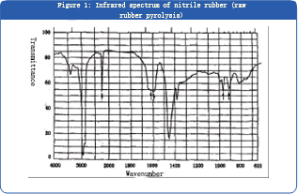 | 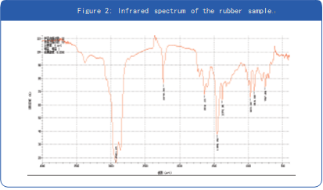 |
When the following absorption peaks appear in the spectrum during pyrolysis, they cannot be used for rubber identification. These absorption peaks include 3330 cm-1, 2860 cm-1, 1700 cm-1, and 1450 cm-1. The characteristic infrared absorption that distinguishes nitrile rubber (NBR) from other rubbers is primarily manifested as a strong absorption between 2000 cm-1 and 2300 cm-1. As can be seen in Figure 2, there is a very strong absorption at 2240 cm-1, confirming that the tested rubber sample is nitrile rubber (NBR).
II.Attenuated Total Reflection (ATR) Method
Thanks to its high-energy output capability and high-sensitivity detector, Fourier Transform Infrared Spectroscopy (FTIR) has made the ATR method widely applicable in recent years for analyzing rubber and its additives. The ATR technique enables direct testing of samples that cannot be measured by conventional transmission methods, allowing surface coatings and difficult-to-prepare materials to be analyzed without sample preparation. This method is particularly suitable for materials such as rubber, plastics, fibers, and elastomers, requiring only minimal sample preparation for measurement.
The ATR accessory, abbreviated as the ATR accessory, is currently offered by infrared accessory manufacturers in four main types: horizontal ATR accessories, variable angle ATR accessories, circular cell ATR accessories, and single-reflection ATR accessories. The first three types belong to multiple internal reflections ATR, while the last type is a single internal reflection ATR. All four types of ATR accessories operate on the same fundamental principle. Compared to traditional testing methods, the ATR method is more convenient and enables faster sample preparation. Its working principle differs slightly from conventional methods, as it measures signal variations during the attenuated phase of total internal reflection.