

Detection Target
Determination of petroleum substances in water
Overview
This solution conforms to the ASTM D3921 Standard Test Method for Oil and Grease and Petroleum Hydrocarbons in Water. This test method defines oil and grease in water and waste water as that matter which is extractable in the test method and measured by infrared absorption. Similarly, this test method defines petroleum hydrocarbons in water and waste water as that oil and grease which is not adsorbed by silica gel in the test method and that is measured by infrared absorption.
The presence of oil and grease in domestic and industrial waste water is of concern to the public because of its deleterious aesthetic effect and its impact on aquatic life. Regulations and standards have been established that require monitoring of oil and grease in water and waste water. This test method provides an analytical procedure to measure oil and grease in water and waste water.
Principle
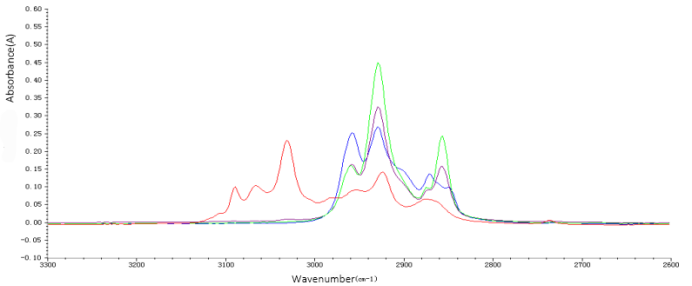
Oil substances in water are mixtures composed of alkanes, cycloalkanes, and aromatic hydrocarbons, which can be extracted using Tetrachloroethylene to determine the total extractable matter. The extracted solution is then treated with magnesium silicate to adsorb polar substances such as animal and vegetable oils, after which the petroleum content is measured. The infrared spectra of petroleum and animal/vegetable oils exhibit absorption peaks at 2930 cm-1, 2960 cm-1, or 3030 cm-1. The content can be calculated based on the absorbance values at these three wavenumbers.
Operating Conditions
Apparatus and Accessories
1) HKL-3921 FTIR Spectrometer for Oil and Petroleum Hydrocarbons in water
2) 1 cm quartz cuvette
Reagents
1) Tetrachloroethylene (C2Cl4), Environmental reagent
2) n-Hexadecane [CH3(CH2)14CH3], Analytical reagent
3) Pristane (2,6,10,14-tetramethylpentadecane), Analytical reagent
4) Toluene (C6H5CH3), Analytical reagent
5) Anhydrous sodium sulfate (Na2SO4), Analytical reagent
6) Sodium chloride (NaCl), Analytical reagent
7) Hydrochloric acid (HCl), Analytical reagent
Sample Pretreatment
Transfer the entire water sample into a separatory funnel. Rinse the sample bottle with 20 ml of Tetrachloroethylene (C2Cl4) and combine the rinse solution with the sample in the separatory funnel. Adjust the pH to ≤2, add 20 g of sodium chloride (NaCl), and shake vigorously for 2 minutes. Allow the mixture to settle completely.
Pass the extract through a glass sintered funnel layered with 10 mm of anhydrous sodium sulfate (Na2SO4), and collect the filtrate in a volumetric flask. Perform a second extraction with 20 ml of Tetrachloroethylene. Rinse the glass funnel with a small amount of C2Cl4, and combine the extract and rinse solution in the volumetric flask. Dilute to the mark with Tetrachloroethylene and mix well.
Test Results
1. Determination of Correction Factors
Using Tetrachloroethylene (C2Cl4) as the solvent, prepare three separate solutions with concentrations of 100 mg/L n-hexadecane, 100 mg/L pristane and 400 mg/L toluene. Using C2Cl4 as the reference solution and a 10 mm × 10mm quartz cuvette, measure the absorbance values (A2930, A2960, A3030) of each solution at 2930 cm-1, 2960 cm-1, and 3030 cm-1, respectively.
The absorbance values of these solutions at the specified wavenumbers conform to the following equation:
C = X·A2930 + Y·A2960 + Z·(A3030 − A2930/F)
Where:
C = Concentration of the compound in the extraction solvent (mg/L).
A2930, A2960, A3030 = Absorbance values at the respective wavenumbers.
X, Y, Z= Correction factors corresponding to C-H bond absorbance.
F = Correction factor for aliphatic hydrocarbons relative to aromatic hydrocarbons, defined as the ratio of absorbance of n-hexadecane at 2930 cm-1 to that at 3030 cm-1.
For n-hexadecane (H) and pristane (P), since they contain no aromatic hydrocarbons, A3030 − A2930/F = 0, thus:
F = A2930(H) / A3030(H)
C(H) = X × A2930(H) + Y × A2960(H)
C(P) = X × A2930(P) + Y × A2960(P)
From these equations, the values of X, Y, and F can be determined.
For toluene (T), the equation becomes: C(T) = X × A2930(T) + Y ×A2960(T) + Z × [A3030(T) − A2930/F], from which the value of Z can be derived.
After calculation, the correction factors are determined as: X = 126.6, Y = 242.5, Z = 1575, F = 63.
2. Verification of Correction Factors
Prepare a mixed hydrocarbon standard by accurately measuring n-hexadecane, pristane, and toluene in a 5:3:1 volume ratio. Precisely weigh an appropriate amount of the mixed hydrocarbon and prepare a series of solutions at different concentrations. Measure their absorbance values at 2930 cm-1 (A2930), 2960 cm-1 (A2960), and 3030 cm-1 (A3030). Calculate the concentration and recovery rate of the mixed hydrocarbon.
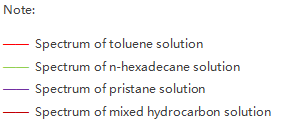
1)Test Spectra
2)Recovery Rate
Serial | Actual Concentration of Mixed Hydrocarbons (mg/L) | Measured Concentration of Mixed Hydrocarbons (mg/L) | Recovery Rate (%) | Average Recovery Rate (%) |
1 | 94.5 | 91.3 | 96.6 | 98.65 |
95.3 | 100.8 | |||
2 | 105.0 | 103.6 | 98.6 | |
103.5 | 98.6 |
Conclusion
The three-wavelength infrared spectroscopy method for determining oil content in water can effectively avoid measurement errors caused by abrupt changes in the relative content of characteristic functional group compounds in samples. A comparison between the mixed hydrocarbon concentrations calculated using the standard formula and their actual values demonstrates that the recovery rates meet environmental monitoring requirements. This method is thus an ideal approach for measuring petroleum-based substances.