

Detection Target
Determination of non-regular additives in Gasoline
Overview
This solution conforms to the GB/T 33648 Test method for identification and determination of specific non-regular additives in motor gasoline—Infrared spectroscopic method. This standard specifies a test method for the rapid identification and determination of typical non-conventional additives in motor gasoline, such as aniline compounds, dimethoxymethane (methylal), and esters, using infrared spectroscopy.
This standard is applicable to the identification and determination of specific non-conventional additives in motor gasoline and gasoline blending components. The concentration ranges for the identification and determination of these additives are as follows: aniline 3 g/L to 35 g/L, N-methylaniline 4 g/L to 35 g/L, dimethoxymethane 3 g/L to 35 g/L, sec-butyl acetate 3 g/L to 35 g/L, and dimethyl carbonate 1.5 g/L to 16 g/L.
Principle
The infrared spectral features of hydrocarbon components in automotive gasoline primarily arise from the stretching and bending vibrations of C-H groups in saturated hydrocarbons, olefins, and aromatic compounds, along with characteristic absorptions from specific functional groups such as double bonds and benzene rings. This method leverages the fact that all target atypical additives exhibit distinct characteristic absorption bands within the FTIR measurement range, which are discernible from those of gasoline's hydrocarbon matrix. Since these additive-specific bands remain unobscured by interference from base gasoline components, they enable unambiguous identification and quantification of non-conventional additives.
Operating Conditions
Apparatus
1)HKL-33648 FTIR Spectrometer for specific non-regular additives in motor gasoline
2)Fixed liquid cell (path length: 0.1 mm) — HF-8
3)Flow-through quantitative wedge cell (path length: 0.1 mm) — Specac Ltd.
Note: Compatible with gasoline component analysis/lubricant component analysis/viscous liquid analysis/flowing sample analysis.
Analysis Conditions
1)Resolution: 4 cm-1
2)Scan times: 64 times
3)Spectral range: 4000–400 cm-1
Reagents
1)Calibration standards (analytical reagent or higher): Aniline, N-Methylaniline, Dimethylaniline, sec-Butyl acetate, Dimethyl carbonate.
2)Mixed solvent (analytical reagent, dilution solvent): Petroleum ether 1 (boiling range 60°C–90°C), Petroleum ether 2 (boiling range 90°C–120°C), and Xylene blended at a volume ratio of 35:35:30
3)Sample cell rinse solvent: n-Hexane (analytical reagent)
Others
1)Analytical balance (accuracy: ±0.0001 g)
2)Rubber bulb
3)Micropipette (100-1000μl)
4)Micropipette (1000-5000μl)
Standard and Sample Preparation
1. Standard Curve Preparation
(1) Preparation of Atypical Additive Stock Solutions
Standard Substances | Aniline | N-Methylaniline | Dimethoxymethane | sec-Butyl Acetate | Dimethyl Carbonate |
Mass (g) | 5.0000 | 5.0000 | 5.0000 | 5.0000 | 5.0000 |
Stock Solution Concentration (g/L) | 200.00 | 200.00 | 200.00 | 200.00 | 200.00 |
(2) Preparation of Standard Curves for Atypical Additives: Different volumes of stock solutions were pipetted to prepare standard solutions at the following concentration series:
Serial | Atypical Additive | Calibration Curve Concentrations (mg/L) |
1 | Aniline | 0.00, 5.00, 10.00, 20.00, 30.00, 35.00 |
2 | N-Methylaniline | 0.00, 5.00, 10.00, 20.00, 30.00, 35.00 |
3 | Dimethoxymethane | 0.00, 4.00, 8.00, 18.00, 25.00, 35.00 |
4 | sec-Butyl Acetate | 0.00, 4.00, 8.00, 18.00, 25.00, 35.00 |
5 | Dimethyl Carbonate | 0.00, 2.00, 4.00, 8.00, 12.00, 16.00 |
2. Preparation of Standard Curves
(1) Using an micropipette (20-200 μl), withdraw aliquots of each standard solution and slowly fill the liquid sample cell to capacity.
(2) Place the liquid cell filled with the standard solution on the sample holder of the Fourier transform infrared (FTIR) spectrometer and record its infrared spectrum. After testing each standard solution, clean the fixed liquid cell using the cell rinsing agent—n-hexane—and dry it by blowing, then proceed to the next standard solution test.
3. Establishment of Quantitative Spectral Lines
Serial | Unconventional Additive | Quantitative Band (cm-1) | Baseline Range (cm-1) |
1 | Aniline derivatives | 3390 | 3320–3550 |
2 | N-Methylaniline | 1320 | 1285–1330 |
3 | Dimethoxymethane | 1141 | 1127–1162 |
4 | sec-Butyl acetate | 1743 | 1685–1770 |
5 | Dimethyl carbonate | 1760 | 1685–1810 |
Result Calculation
Based on the absorbance value of the quantitative characteristic spectral line measured from the spectrum, the concentration of additive (i) in the analytical sample is calculated. If the sample was diluted, the actual concentration of the additive in the sample should be determined by multiplying the calculated concentration by the dilution factor.

Where:
ci— Mass concentration of additive (i) in the measured sample, expressed in grams per liter (g/L).
Yi— Absorbance value of additive (i) obtained from spectral measurement.
ai, bi— Calibration curve parameters for additive (i).
S — Dilution factor of the measured sample.
Test Results
1.Establishment of Standard Curves
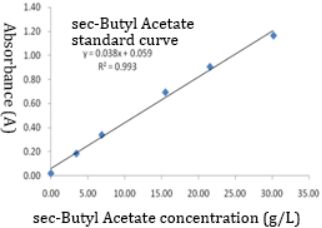
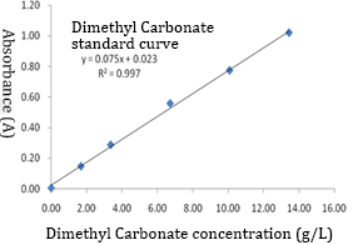
The standard curve for atypical additives was constructed according to the reference standard. Infrared spectra of different atypical additives at varying concentrations were obtained as shown in the figure below. Each sample was scanned three times, and the arithmetic mean of the three measurements was taken as the final result.
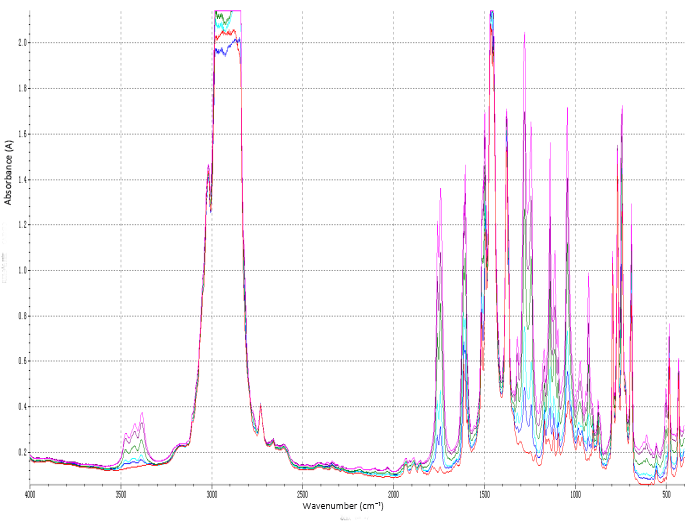 |
Figure 1 The red spectrum, dark blue spectrum, light blue spectrum, dark green spectrum, purple spectrum, and pink-purple spectrum correspond to the blank sample and the test spectra of five mixed standard solutions, respectively, with concentrations showing an increasing trend. |
2.Test Results
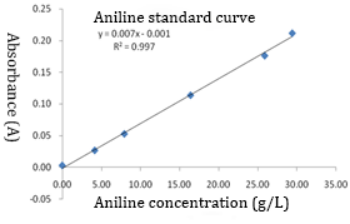 | 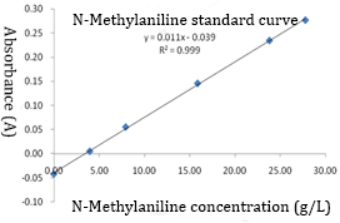 |
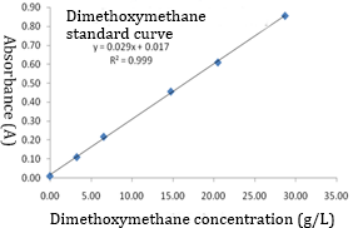 |  |
 | |
3.Conclusion
The infrared spectroscopy method demonstrated accurate and rapid determination of atypical additives in gasoline. The calibration curves exhibited excellent linearity (R²≈1), fully meeting the requirements for quantitative analysis.
Configuration
Features
1) Highly stable optical system: Integrated Optical Bench Design with Sealed Interferometer, featuring rapid humidity status detection capability.
2) High-performance electronic system: Equipped with the latest 24-bit A/D converter and a 500 kHz A/D conversion speed, combined with an imported high-sensitivity infrared detector, it achieves real-time spectral data acquisition, ensuring data authenticity and reliability.
3) User-friendly humidity protection design: Featuring a sealed interferometer design with quick humidity status recognition, this system reduces maintenance workload for operators. Desiccant replacement can be performed without opening the instrument cover.
4) Gold-Plated Corner Mirror (including both Moving and Fixed Mirrors) Integrated One-Piece Molded Design. This design ensures perfect mirror matching consistency, while the enlarged reflective surfaces with gold-plating deliver enhanced light throughput and superior reflectivity. Furthermore, the precision-engineered right-angle surfaces eliminate the need for adhesive bonding, making the mirrors immune to temperature variations and thereby maximizing instrument stability.
Technical Parameters
1) Spectral Range: 7800-350 cm-1
2) Resolution: better than 1.0 cm-1
3) Signal-to-Noise Ratio: better than 30000:1 (peak-to-peak value at 2100 cm-1, 4 cm-1 resolution, 1-minute background and sample scans)
4) Detector: Original imported high-sensitivity infrared detector
5) Beam Splitter: Original imported KBr with multilayer coating and moisture-proof coatin
6) Scanning Speed: Computer-controlled with selectable scanning speeds, continuously adjustable, automatic spectrum comparison
7) Light Source: Original imported long-life high-intensity air-cooled system infrared source
8) Wavenumber Accuracy: 0.01 cm-1
9) Noise Level: <4.3×10⁻⁵ A
10) Power Supply: AC 220V, 50Hz
11) Data Interface: High-speed USB 2.0
12) Operating System: Windows 7/Windows 10
Software Workstation
1) HKL-33648 FTIR Spectrometer for specific non-regular additives in motor gasoline Workstation supports annotations for spectra, featuring spectrum retrieval/comparison, self-diagnosis, user-defined spectrum addition, spectral matching analysis, and standard file formats.
2) Standard Polymer Spectral Library: Includes over 100000 infrared reference spectra for rapid and accurate identification of unknown substances.
3) Professional video operation guides available upon request.
configuration
Category | Name | Model | Specifications |
Main Unit | Fourier Transform Infrared Spectrometer | HKL-33648 FTIR Spectrometer for specific non-regular additives in motor gasoline | 1 unit |
Operating Software | Software Workstation | Dedicated | Includes lifetime free software upgrades, 1 set |
Dedicated Accessories | Fixed Liquid Cell | HF-8 | 1. Path length: 0.1mm, 2. KBr windows 3. Wavelength:7000-400 cm-1 (transmission analysis) 4. 2 sets |
Wedge Flow-Through Cell | SPECAC | 1. Optical path: 0.1mm 2. Originally imported, with zinc selenide (ZnSe) window. | |
Laboratory Equipment | Drying Oven | HW-9 | 1. Organic glass material (Protects core components from environmental damage and extends service life) 2. 1 unit |
