
Detection Target
Determination of Sulfur Compounds in Natural Gas and Gaseous Fuels
Overview
This solution conforms to ASTM D6228 Standard Test Method for Determination of Sulfur Compounds in Natural Gas and Gaseous Fuels by Gas Chromatography and Flame Photometric Detection. Many sources of natural gas and petroleum gases contain varying amounts and types of sulfur compounds, which are odorous, corrosive to equipment, and can inhibit or destroy catalysts used in gas processing. Their accurate measurement is essential to gas processing, operation, and utilization. Small amounts, typically, 1 to 4 ppmv of sulfur odorant compounds are added to natural gas and liquefied petroleum (LP) gases for safety purposes. Some odorant compounds can be reactive and may be oxidized, forming more stable compounds having lower odor thresholds. These gaseous fuels are analyzed for sulfur odorants to help ensure appropriate odorant levels for safety.
Apparatus
HKL-6228 GC for Sulfur Compounds in Natural Gas and Gaseous Fuels
Features
Imported 10.2-inch (1280×800) color touchscreen for intuitive operation.
8-channel temperature control and 8 external event inputs for precise process management.
Full remote control via PC software enables temperature and detector parameter configuration.
Logarithmic amplifier design prevents solvent peak saturation during analysis.
Real-time chromatogram display with triple-channel simultaneous viewing on screen.
Auto-ignition function for FID (Flame Ionization Detector) and FPD (Flame Photometric Detector).
8-zone temperature control with over-temperature protection; any zone exceeding limits triggers automatic power cutoff and alarms.
Programmable temperature ramping: 8-stage standard, unlimited stages via software programming.
Digital gas flow rate display on screen, eliminating need for analog pressure gauges.
Simultaneous acquisition of signals from ≥3 detectors.
Hydrogen leak protection and carrier gas saver mode: Automatically switches to low-split mode post-injection, reducing gas consumption and operational costs.
Single Ethernet cable enables instrument control and data signal transmission.
Workstation-based parameter configuration for true bidirectional remote control.
Bidirectional communication between touchscreen and workstation.
Technical Parameters
Temperature control range: +5 °C to 400 °C, adjustable in 0.1 °C increments.
Communication interface: Ethernet.
Programmable temperature ramping: 8 stages with a rate of 0.1–40 °C/min.
Dimensions: 555*525*485 mm (L*W*H)
Detector Parameters:
1) FPD
2) Baseline noise≤0.05mv
3) Baseline drift≤0.5mv/30min
4) Limit of detection: S≤8*10*12g/s
5) LOD of H2S: 10ppb
Configuration
No. | Item | Specification | Application | Qty. |
1 |
Gas chromatograph |
GC | 10.2-inch color touchscreen with boot-up self- check, broad-range self-diagnostic function, and intelligent fuzzy-control rear vent system. Real-time chromatogram display on screen. Programmed temperature ramping: 8 standard stages, extendable to unlimited stages via programming. Digitally controlled valve adjustments. FID auto-ignition function. Integrated with sample injection system, gas switching system, self-diagnostic system, and self-protection system. |
1 set |
2 | Flame Photometric Detector | FPD | Analysis: Trace Sulfides | 1 set |
3 | Valve | Six-way | Corrosion resistance | 1 set |
4 | Column | PTFE | Dedicated for sulfide | 1 set |
5 | Standard Gas | 4L | For calibration | 1 tank |
6 | Hydrogen Generator | Fuel Gas | 1 set | |
7 | Air Generator | Combustion-supporting | 1 set | |
8 | PC + Printer | Self-prepared | Data processing | 1 set |
9 | Carrier Gas | Self-prepared | 40L, 99.999% | 1 tank |
10 | Accessory bag | 1 set | ||
11 | ||||
12 |
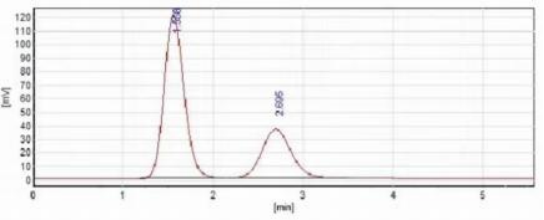
Chromatogram