

1. Detection Target
Determination of 9 Heavy Metals in Water: Cobalt (Co), Nickel (Ni), Cadmium (Cd), Barium (Ba), Chromium (Cr), Copper (Cu), Lithium (Li), Manganese (Mn), Strontium (Sr)
2. Overview
This solution conforms to the ISO 11885 Water quality — Determination of selected elements by inductively coupled plasma optical emission spectrometry (ICP-OES). This International Standard specifies a method for the determination of dissolved elements, elements bound to particles and total content of elements in different types of water (e.g. ground, surface, raw, potable and waste water) for the following elements: aluminium, antimony, arsenic, barium, beryllium, bismuth, boron, cadmium, calcium, chromium, cobalt, copper, gallium, indium, iron, lead, lithium, magnesium, manganese, molybdenum, nickel, phosphorus, potassium, selenium, silicon, silver, sodium, strontium, sulfur, tin, titanium, tungsten, vanadium, zinc and zirconium.
3. Introduction
Heavy metal pollution in water is becoming increasingly serious, and scientific and accurate analysis of heavy metals in water has become an essential task in environmental monitoring. Test results show that the method detection limits, precision, accuracy, and spike recovery rates for nine elements (cobalt, nickel, cadmium, barium, chromium, copper, lithium, manganese, and strontium) all meet the requirements of the technical guidelines, demonstrating that all laboratory analytical conditions meet the testing requirements. Compared to atomic absorption spectrophotometry, inductively coupled plasma optical emission spectrometry offers the advantages of simultaneous multi-element determination and a simple, rapid analytical method, capable of analyzing all nine elements.
4. Test Preparation
4.1 HKL-11885 ICP for Determination of selected elements in water
1) Nebulizer gas flow: 0.70 L/min
2) Plasma cooling gas flow: 1.0 L/min
3) Auxiliary gas flow: 0.20 L/min
4) RF power: 1300 W
5) Sample uptake time: 30 s (radial view)
4.2 Reagents
1) 24-element mixed Calibration standard solution: Concentration of 100 µg/ml
2) Nitric acid (HNO₃): Guaranteed Reagent
3) Argon and nitrogen: Purity ≥99.999%
4) Ultrapure water: Resistivity >18.2 MΩ ·cm
4.3 Establishment of Standard Curves
Due to variations in instrument response values for different elements, two separate standard curves were prepared.
Curve 1 was used for the determination of Co, Ni, Cd, and Ba. A 5.00 ml aliquot of a 100 µg/ml mixed standard solution was diluted to 50 ml with (1+99) HNO₃, yielding a 10 µg/ml stock solution. Six 100 ml volumetric flasks were prepared with 0.00, 1.00, 2.00, 4.00, and 7.00 ml of the stock solution, diluted with (1+99) HNO₃, resulting in standard concentrations of 0.00, 0.10, 0.20, 0.40, and 0.70 mg/L.
Curve 2 was used for the determination of Cr, Cu, Li, Mn, and Sr. Similarly, a 5.00 ml aliquot of a 100 µg/ml mixed standard solution was diluted to 50 ml with (1+99) HNO₃, yielding a 10 µg/ml stock solution. Six 100 ml flasks were prepared with 0.00, 1.00, 2.00, 4.00, and 5.00 ml of the stock solution, yielding standard concentrations of 0.00, 0.10, 0.20, 0.40, and 0.50 mg/L. Measurements were taken at optimal or suboptimal wavelengths, and correlation coefficients (R) for each element are listed in Table 1.
5. Test Procedure
Pretreatment of soluble metals in clean surface water and groundwater: Following sample collection, the water is filtered through a 0.45-µm membrane filter, with the initial 50–100 ml of filtrate discarded. A representative volume of the filtered sample is then collected and acidified with (1+1) nitric acid to pH <2 for preservation prior to instrumental analysis.
6. Results and Error
6.1 Method Detection Limit (MDL)
Since no target substances were detected in reagent blanks, samples with concentrations approximately 3-5 times the estimated MDL were analyzed in seven replicate measurements. The standard deviation (S) was calculated, and the MDL was determined using the prescribed formula.
6.2 Standard Deviation
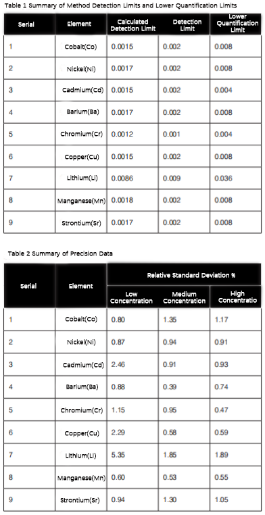
The MDLs for nine elements (Co, Ni, Cd, Ba, Cr, Cu, Li, Mn, Sr) were determined at concentrations 3-5 times the estimated MDL. As shown in the table below, the MDLs ranged from 0.001 to 0.009 mg/L, with reporting limits (RLs) between 0.004 and 0.036 mg/L, all significantly lower than the regulatory requirements.
6.3 Precision
Precision refers to the degree of agreement among repeated measurements of a homogeneous sample under controlled conditions, reflecting the random error of the analytical method. Lower random error indicates higher precision. Precision was evaluated at low, medium, and high concentrations (Table 2). The relative standard deviation (RSD) ranged from 0.39% to 5.35%, demonstrating good repeatability. Except for Li at low concentrations, all elements exhibited low RSDs, confirming stable instrument performance and minimal procedural variability.
6.4 Accuracy Summary
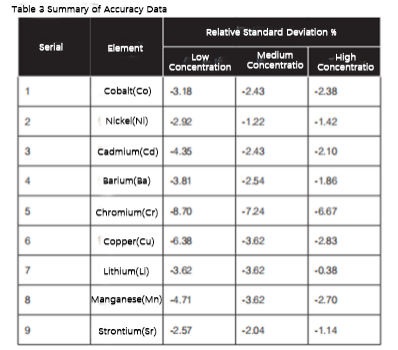
Accuracy is commonly used to evaluate the conformity between the analytical results (single measurements or means of repeated measurements) obtained by a specific analytical procedure and the assumed or accepted true value. The accuracy of an analytical method or system reflects the combined systematic and random errors, serving as a comprehensive indicator of the reliability of the results. In this study, the accuracy of nine elements (Co, Ni, Cd, Ba, Cr, Cu, Li, Mn, Sr) was tested using three concentration levels, as presented in Table 3. The relative deviation ranged from -8.70% to -0.38%. Most elements exhibited lower values within the quality control range, with chromium showing notably lower accuracy, likely due to significant interference.
 |  |
6.5 Summary of Spike Recovery
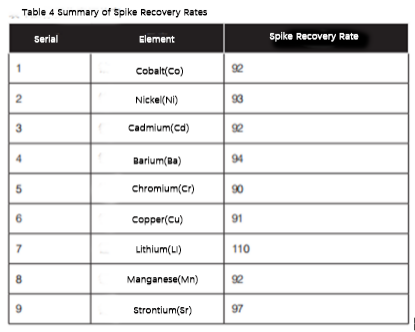
Spike recovery is another key metric for evaluating accuracy. Known amounts of standard reference materials were spiked into real samples, and the recovery rates were calculated. As shown in Table 4, the spike recovery rates for the nine elements (Co, Ni, Cd, Ba, Cr, Cu, Li, Mn, Sr) ranged between 90% and 110%, indicating minimal random and systematic errors and confirming the stability and reliability of the analytical process.
7. Conclusions
Through the analytical testing of detection limits, precision, accuracy, and spike recovery for nine elements (Co, Ni, Cd, Ba, Cr, Cu, Li, Mn, Sr):
(1) Detection limits: 0.001–0.009 mg/L Quantification limits: 0.004–0.036 mg/L Significantly lower than the method-defined detection limits.
(2) Precision: Relative standard deviation (RSD) ranged from 0.39% to 5.35%, demonstrating good repeatability.
(3) Accuracy: Relative bias ranged from -8.70% to -0.38%
(4) Spike recovery rates were between 90% and 110%.