

Detection Target
Determination of oil content in liquefied anhydrous ammonia
Overview
This solution conforms to the ISO 7106 Liquefied anhydrous ammonia for industrial use — Determination of oil content — Gravimetric and infra-red spectrometric methods. This International Standard specifies two methods for the determination of the oil content non volatile at about 105 °C, of liquefied anhydrous ammonia for industrial use, namely: a gravimetric method and an infra-red spectrometric method. The gravimetric method is applicable to products having an oil content equal to or greater than 10 mg/kg. The infra-red spectrometric method, being more sensitive, is applicable to products having an oil content greater than 1 mg/kg. Principle At room temperature, after evaporating the liquid ammonia sample, the oil in the residue is extracted using Tetrachloroethylene. The absorbance of the organic phase is measured at a fixed wavelength of approximately 3.42 μm (corresponding to the strongest absorption band of the asymmetric vibration of CH groups) to determine the oil content in anhydrous liquid ammonia.
Operating Conditions
Apparatus and Accessories
1) HKL-7106 FTIR Spectrometer for oil content in Liquefied anhydrous ammonia
2) Liquid Test Accessory: Stoppered quartz cuvette (1 cm path length)
Others
1) Tetrachloroethylene (C2Cl4)
2) Paraffin oil standard solution
Test Conditions
1) Resolution: 4 cm-1
2) Scan times: 32
3) Detector: Pyroelectric Infrared Detector
Preparation of Test Solution
Remove the oil-containing platinum evaporation dish from the desiccator.
Add 10 ml of Tetrachloroethylene (C2Cl4) to dissolve the oil.
Transfer the solution to a 50 ml volumetric flask.
Rinse the dish 2–3 times with additional C2Cl4, then dilute to the mark with C2Cl4 and mix thoroughly for analysis.
Standard Curve Preparation
1.Inject paraffin oil standard solutions (containing 0.25 mg, 0.50 mg, 1.00 mg, 1.50 mg, 2.00 mg, and 2.50 mg of paraffin oil) sequentially into stoppered quartz cuvettes. Using C2Cl₄ as the background, measure the absorbance at ~3.42 μm (2924 cm⁻¹), corresponding to the maximum absorption peak of CH stretching vibrations.
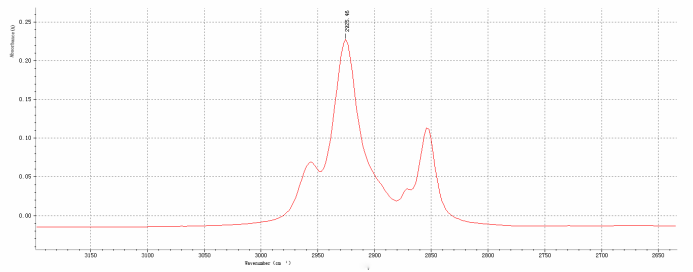
2. Plot the standard curve with absorbance (y-axis) against paraffin oil mass (x-axis) (see figure below).
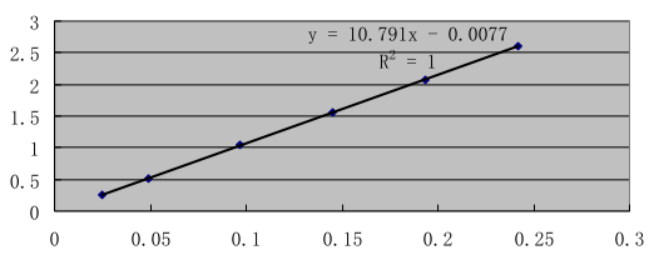
Conclusion
The infrared spectrometric method with standard curve calibration enables accurate and rapid determination of oil content in anhydrous liquid ammonia. The calibration curve demonstrates near-perfect linearity with R²=1, fully meeting quantitative analysis requirements.