
Detection Target
Determination of Oxygenates in C2, C3, C4, and C5 Hydrocarbon Matrices
Overview
This solution conforms to ASTM D7423 Standard Test Method for Determination of Oxygenates in C2, C3, C4, and C5 Hydrocarbon Matrices by Gas Chromatography and Flame Ionization Detection. A gas Chromatograph determines the quantities of oxygenates in light hydrocarbon streams like ethene, propene, 1-3 butadiene, C4 hydrocarbons, and C5 hydrocarbons. Oxygenates (such as alcohols, ethers, aldehydes, and ketones) present in these hydrocarbon streams can decrease catalyst activity in downstream polymerization processes.
Summary
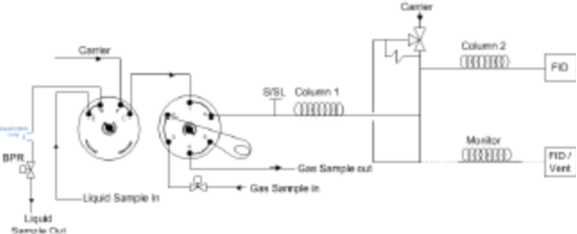
The GC is intended to determine the mass concentration of each oxygenate in the hydrocarbon matrix. The detector response and retention times for each oxygenate peak in a calibration standard is measured and used to externally calibrate the flame ionization detector response. The concentration of each oxygenate is calculated by the external standard technique. The gas chromatograph all flows are EPC controlled. The sample is introduced in the system through the Automatic Liquid Sampler, LSV or GSV in the Split/Split less Inlet (S/SL). A pre separation is made on the precolumn. The oxygenated components are cut from the matrix by applying a pressure switch, directing the effluent from the pre column either to the monitor column or to the analysis column. The oxygenates are separated on the analysis column in a temperature programmed oven run and detected by the Flame Ionization Detector.
Apparatus
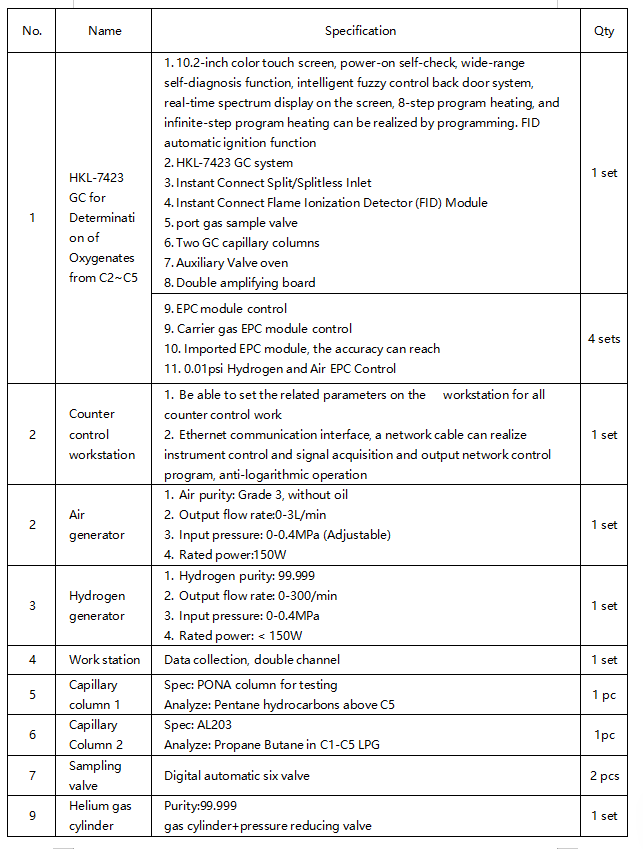
HKL-7423 GC for Determination of Oxygenates from C2~C5
Features
Adopts imported 10.2 inch (1280X800) color touch screen.
8 channels control the temperature, 8 external events.
Be able to set flow rate, pressure, temperature and detector parameters on the PC (Function depends on the exact model).
Logarithmic amplifier, no flat solvent peak.
Screen real-time spectrum display, be able to display three-channel spectrum simultaneously.
FID and FPD automatic ignition.
8 channels temperature control, if any channel overtemperature, the system will stop heating and alarm automatically.
Program heating: 8 steps, be able to do infinite steps heating via programming.
Every flow rate can be displayed on the screen, no need the pointer pressure gauge.
At lease3 detectors signal acquisition simultaneously.
Hydrogen leak protection and carrier gas saving mode: The tester will automatically enter the low-split mode after the injection, which greatly reduces the consumption of carrier gas and operating cost.
Only one cable can control the tester and data signal output.
Advanced EPC system, maximum 12 channel electric flow control modules are available.
Be able to set the related parameters via the workstation.
Two-way communication between screen and counter control workstation.
Adopts imported EPC module.
Technical Parameters
Method: ASTM D7423
Channel: 2
Sample type: Gas or liquid
Detection: FID
Detection limit: 0.5ppm
Working range: 0.50~100mg./kg
Sample limitation: Matrix bp<200℃
Temperature controlling range: +5~400℃, increment 0.1℃
Programming temperature rising: 8 stages rate 0.1-40℃
Communication port: Ethernet
Dimension: 555*525*485mm
Air flow Diagram
Components
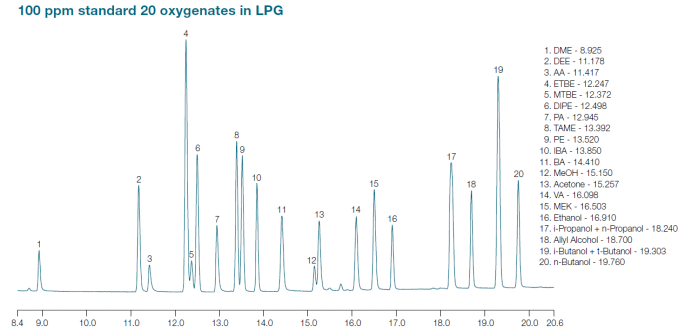
Dimethyl ether | Diethyl ether | Acetaldehyde |
Ethyl tert-butyl ether | Methyl tert-butyl ether (MTBE) | Diisopropyl ether |
Propionaldehyde (Propanal) | Tertiary amyl methyl ether (TAME) | Propyl ether |
Isobutylaldehyde | Butylaldehyde | Methanol |
Acetone | Isovaleraldehyde | Valeraldehyde |
2-Butanone (MEK) | Ethanol | N-propyl alcohol and isopropanol (co-elution) |
Allyl alcohol | i-Butanol, t-Butanol, s-Butanol (co-elution) | N-butanol |
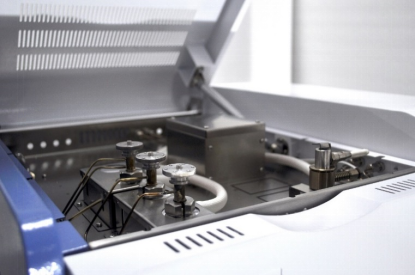 | 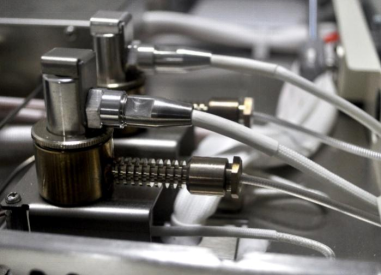 |
Chromatogram
Configuration