

Detection Target
Measurement of Carbon and Oxygen Content in Silicon
Overview
This solution conforms to the ASTM F1188 Standard Test Method for Interstitial Atomic Oxygen Content of Silicon by Infrared Absorption and SEMI MF1391 Test Method for Substitutional Atomic Carbon Content of Silicon by Infrared Absorption.
ASTM F1188 covers the determination of the interstitial oxygen content of single crystal silicon by infrared spectroscopy. The useful range of oxygen concentration measurable by the test method is from 1 ×10¹⁶ atoms/cm3 to the maximum amount of interstitial oxygen soluble in silicon. SEMI MF1391 utilizes the relationship between carbon concentration and the absorption coefficient of the infrared absorption band associated with substitutional carbon in silicon. At room temperatures (about 300 K), the absorption band peak is at 605 cm-1 or 16.53 μm. At cryogenic temperatures (below 80 K), the absorption band peak is at 607.5 cm-1 or 16.46 μm.
Principle
The substitutional carbon atoms and interstitial oxygen atoms in silicon exhibit characteristic absorption peaks at wavenumbers 607.2 cm-1 and 1107 cm-1, respectively. By measuring the absorption coefficients of these peaks, the concentrations of substitutional carbon and interstitial oxygen can be determined.
Operating Conditions
Instrument and Accessories
1) HKL-1188 FTIR for Carbon and Oxygen Content In Silicon
2) Oxygen/Carbon Testing Accessory: Silicon Oxygen-Carbon Measurement Stage
Test Parameters
1) Resolution: 2 cm-1
2) Scan times: 64
3) Detector: Pyroelectric Infrared Detector
Others
1) Micrometer: Accuracy of 0.01 mm
2) Hydrofluoric Acid (HF): Analytical Reagent (A.R.)
Sample Preparation
According to the requirements, appropriate reference silicon wafers and sample silicon wafers were selected. Surface oxides were removed using hydrofluoric acid (HF), and their thickness was measured prior to testing.
Sample Testing
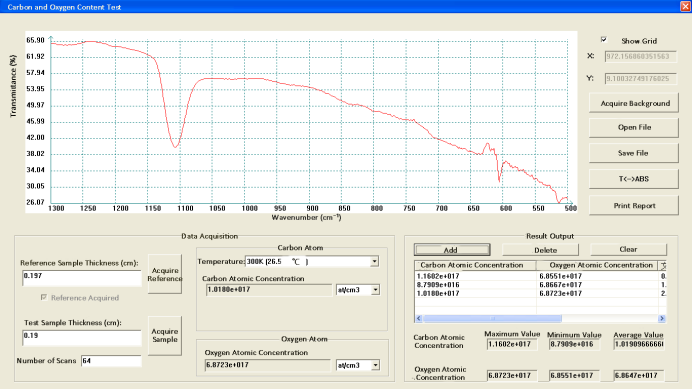
1. Using the HKL-1188 FTIR for Carbon and Oxygen Content analysis software for silicon, perform the following steps in sequence: Background scan → Enter reference thickness → Scan reference sample → Enter sample thickness → Scan sample → Record data.
2. Repeat the sample scan twice and record the data to obtain the results as shown in the figure below.
|
Figure 1 Test Results of Oxygen and Carbon Content in Silicon |
3. Testing Data
Parameters | 1 | 2 | 3 | Average | Standard Deviation |
Carbon concentration (1017 at/cm3) | 1.16 | 0.879 | 1.02 | 1.02 | 0.14 |
Oxygen concentration (1017 at/cm3) | 6.85 | 6.86 | 6.87 | 6.86 | 0.01 |
Conclusion
The HKL-1188 FTIR for Carbon and Oxygen Content analysis software provides a convenient and rapid method for quantitative determination of substitutional carbon and interstitial oxygen in monocrystalline silicon materials.