

Detection Target
Screening of Phthalates in Plastics
Overview
Many common plastic consumer products contain high concentrations of toxic chemical additives—phthalates. Phthalates are used as plasticizers to make plastics more flexible, economically durable, and soft. Typically, 15-30% phthalates are added to base polymers such as polyvinyl chloride (PVC, vinyl) and other widely used polymers. Since no chemical bond exists between the plasticizer and the polymer, phthalates can easily leach out, contaminating the surrounding environment or being ingested accidentally. As endocrine disruptors, exposure to phthalates can trigger various physiological effects, including obesity, insulin resistance, kidney and liver damage, attention deficit hyperactivity disorder (ADHD), and other potential impacts on the nervous system of children.
Using the HKL-FTIR Spectrometer for Phthalates In Plastics offers significant advantages including simple operation, no sample pretreatment, short analysis time, and non-destructive identification. This approach substantially improves work efficiency and economic benefits.
Principle
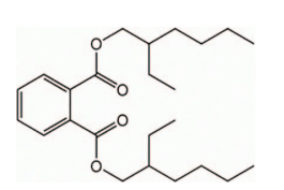
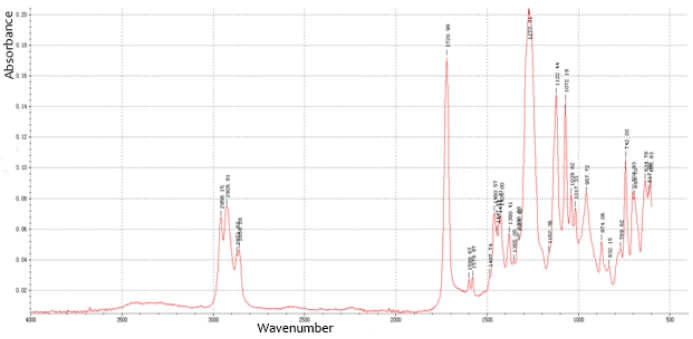
For a PVC sample substrate, phthalate esters are diesters of phthalic acid, exhibiting a C=O stretching vibration at 1725 cm-1. Taking DEHP as an example, it contains an ortho-substituted aromatic ring, which shows a strong absorption band at 741 cm-1. The aromatic ring skeleton stretching vibrations appear as a doublet at 1600 cm-1 and 1581 cm-1, while the C-O-C stretching vibrations display distinct absorption peaks at 1267 cm-1 and 1119 cm-1. Notably, the absorption band at 1267 cm-1 is broad and intense, often exhibiting comparable intensity to the 1725 cm-1 absorption band.
|
The chemical structure of di(2-ethylhexyl) phthalate (DEHP) |
Operating Conditions
Instrument and Accessories
1)HKL-FTIR Spectrometer for Phthalates In Plastics
2)Single-reflection ATR accessory (diamond crystal, 45° incidence angle).
Test conditions
1)Resolution: 4 cm-1
2)Scan times: 64
3)Spectral range: 4000–600 cm-1
Test Procedures
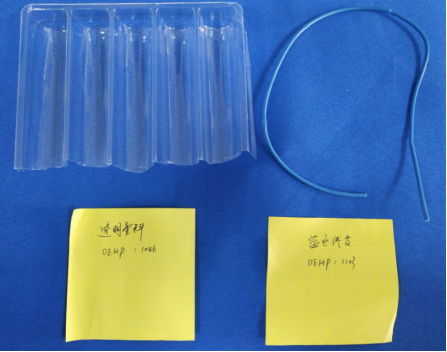
The following three samples were analyzed using the single-reflection ATR:
1)DEHP-exceeded samples: DEHP 1046 ppm and DEHP 1123 ppm
2)Children’s toy sample: yellow duck.

Test Results
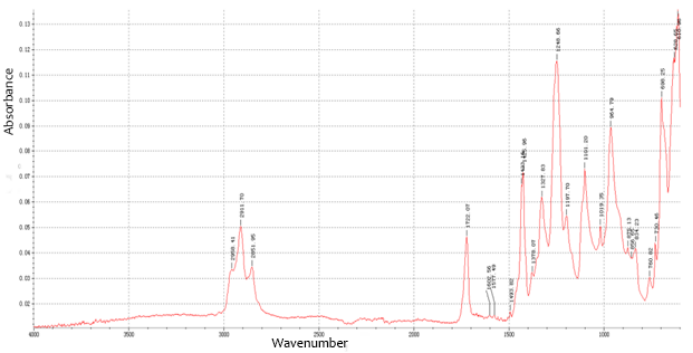
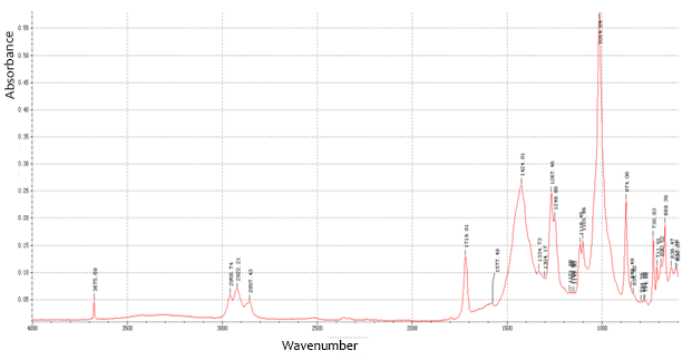
1.DEHP-exceeded samples: DEHP 1046 ppm and DEHP 1123 ppm were detected.
|
Figure 1 FTIR Spectrum of DEHP (1046 ppm) |
|
Figure 2 FTIR Spectrum of DEHP (1123 ppm) |
2.Children’s toy sample: yellow duck.
|
Figure 3 FTIR Spectrum of Children’s toy |
Conclusion
Since the DEHP content of 1046 ppm is lower than that of 1123 ppm, its absorption peak at 1267 cm-1 was not resolved, and the overall infrared absorption peaks were relatively weak. This indicates that the method can effectively screen for phthalates in plastic products (such as PVC).
Tests have confirmed that children's toys contain plasticizers, demonstrating that this method can achieve preliminary and rapid screening for phthalates in plastic (e.g., PVC) products.